The Impact of Managed IT on Employee Productivity
 Adam Quan is the President of Greenville IT Solutions, an award-winning provider of managed IT services to over 200 businesses and nonprofits in the Southeast.

In today’s fast-paced business world, boosting employee productivity hinges on reliable technology. IT managed services from trusted Managed Service Providers (MSPs) deliver proactive managed IT services and essential IT support, ensuring seamless tools like Microsoft Teams. Discover how managed services slash downtime, enhance security, and drive measurable gains — unlocking your team’s full potential.
Key Takeaways:
- Managed IT minimizes downtime through proactive monitoring, ensuring employees stay productive without interruptions from technical issues.
- Enhanced security via proactive threat detection boosts employee confidence, allowing focus on tasks rather than cyber worries.
- Streamlined access to tools and resources eliminates delays, directly increasing efficiency and overall productivity gains.
What Is Managed IT?
Managed IT services involve outsourcing IT infrastructure management to specialized MSPs, handling everything from network monitoring to cybersecurity threats for a predictable monthly fee. These providers offer a full suite of services, including 24/7 monitoring, help desk support, and cloud services. Unlike traditional in-house IT teams that focus on fixing problems after they occur, MSPs provide proactive support to prevent issues.
According to Gartner, the MSP market will exceed $200 billion by 2025, driven by businesses seeking reliable IT services without the overhead of full-time staff. Adopting managed IT leads to three key benefits that directly impact employee productivity: significant downtime reduction, enhanced security against evolving cybersecurity threats, and cost effectiveness through scalable flexibility. Managed it services in greenville sc providers deliver all three for Greenville businesses looking to maximize their workforce potential.
Key Components of Managed IT Services
Managed IT services deliver comprehensive coverage through 8 core components that proactively maintain system performance and prevent disruptions. These components work together to tackle common challenges like server crashes, network connectivity problems, and cybersecurity threats. Companies report up to 40% improvement in system performance after implementing full managed IT services.
24/7 Network Monitoring and Help Desk
Applixure-powered 24/7 network monitoring detects 95% of issues before user impact, while priority help desk resolves 80% of tickets within 1 hour. Real-time monitoring dashboards track key metrics like CPU usage exceeding 80%, disk space below 20%, and bandwidth spikes. Help desk teams use structured SLAs: P1 critical issues respond in under 15 minutes, P2 in less than 1 hour.
Actual ticket metrics show 85% first-contact resolution for issues like phishing threats or Microsoft Teams glitches. Businesses see direct gains in employee satisfaction as tech frustrations drop, with quarterly reports highlighting 60% fewer downtime incidents. This directly supports the impact of managed IT on employee productivity by keeping workers in flow without IT interruptions.
Patch Management and Software Updates
Automated patch management reduces vulnerability exposure by 92%, deploying Microsoft Office 365 and security updates during off-peak hours. The Patch Tuesday process schedules deployments from 2AM to 5AM, minimizing impact on daily operations. Tools like WSUS for Windows and Applixure for multi-OS environments ensure consistent software updates across devices — unpatched systems face 3x higher hack risk per Verizon DBIR data.
Administrators receive detailed compliance reports, tracking 98% patch success rates. Results include stronger defense against cybersecurity threats and 75% fewer vulnerabilities, with companies reporting smoother remote communication and higher productivity as systems run optimally.
Data Backup and Disaster Recovery
3-2-1 backup strategy (3 copies, 2 media, 1 offsite) via Microsoft OneDrive Business ensures 99.9% data recovery within 4 hours. This follows strict RPO targets of 1 hour for data loss prevention and RTO of 4 hours for system restoration. In one case, 100% data was restored in 3.5 hours versus industry average of 72 hours.
Organizations achieve cost effectiveness with encrypted offsite storage and automated alerts for failures. Recovery success boosts confidence in technology optimization, cutting recovery costs by 50% — and enhanced data security directly lifts productivity by eliminating recovery-related delays.
How Managed IT Reduces Downtime
Managed IT cuts unplanned downtime by 88% according to a Harvard Business study, dropping from 8.8 hours/month to 1.1 hours and saving mid-sized firms $5,600/hour. Managed service providers follow a structured process to minimize outages:
- Predictive analytics provides up to 2-hour warnings for potential failures by analyzing system performance data in real time.
- Automated failover switches operations in just 30 seconds, ensuring continuous access to cloud services and unified communications.
- Post-incident root cause analysis identifies vulnerabilities for future prevention, enhancing overall technology optimization.
These steps lead to impressive metrics, with server crashes reduced by 94% and network connectivity issues down 87%. The return on investment proves compelling, delivering $300,000 in annual savings for typical operations through lower repair costs and sustained productivity. This connects to IT support strategies for minimizing downtime as a core deliverable of managed IT partnerships.
Improved Security and Employee Confidence
Managed security stops 99.7% of cybersecurity threats before breach while boosting employee confidence 42% through seamless protection. Employees are 3x more productive without constant threat fear, according to Gartner. With managed IT services, teams focus on core tasks instead of worrying about data breaches or phishing attacks, creating a safer environment where workers engage fully in their roles.
Proactive Threat Detection
AI-driven threat hunting blocks phishing threats 48 hours before execution using next-gen firewalls and behavior analytics. Managed IT services employ a robust security stack including EDR from CrowdStrike, firewalls from Palo Alto, and antivirus from Bitdefender. This combination stops 2.4 million phishing emails quarterly, safeguarding sensitive data across email, Microsoft Office 365, and Slack integrations.
One standout example involved a prevented ransomware incident that saved $1.2 million in potential losses. Employee training via KnowBe4 boosts phish recognition to 92%, integrating seamlessly with daily workflows. Greenville it support teams deliver this proactive threat detection as part of comprehensive managed security packages, supporting managed IT for businesses that store sensitive client data across regulated industries.
Streamlined Access to Tools and Resources
Single-pane-of-glass access to Microsoft Teams, Google Workspace, Slack, and Zoom reduces app-switching time by 67%, enabling instant collaboration. Implementation starts with SSO and MFA setup, which takes about 5 days for most organizations, ensuring secure single-sign-on access across all apps.
| Tool | Users | Integration | Uptime | Cost |
|---|---|---|---|---|
| Microsoft Teams | 300M | Office 365 native | 99.99% | $6/user |
| Google Workspace | — | Cloud native | 99.9% | $6/user |
| Slack | — | API-based | 99.99% | $7.25/user |
| Zoom | — | OAuth | 99.99% | $15/user |
Remote work optimization comes from 24/7 monitoring and network monitoring, which maintain uptime during off-hours. Tips include prioritizing cloud services for scalability, enabling help desk integration for quick resolutions, and using software management for automatic updates. These steps support how managed IT helps improve office communication tools across distributed teams.
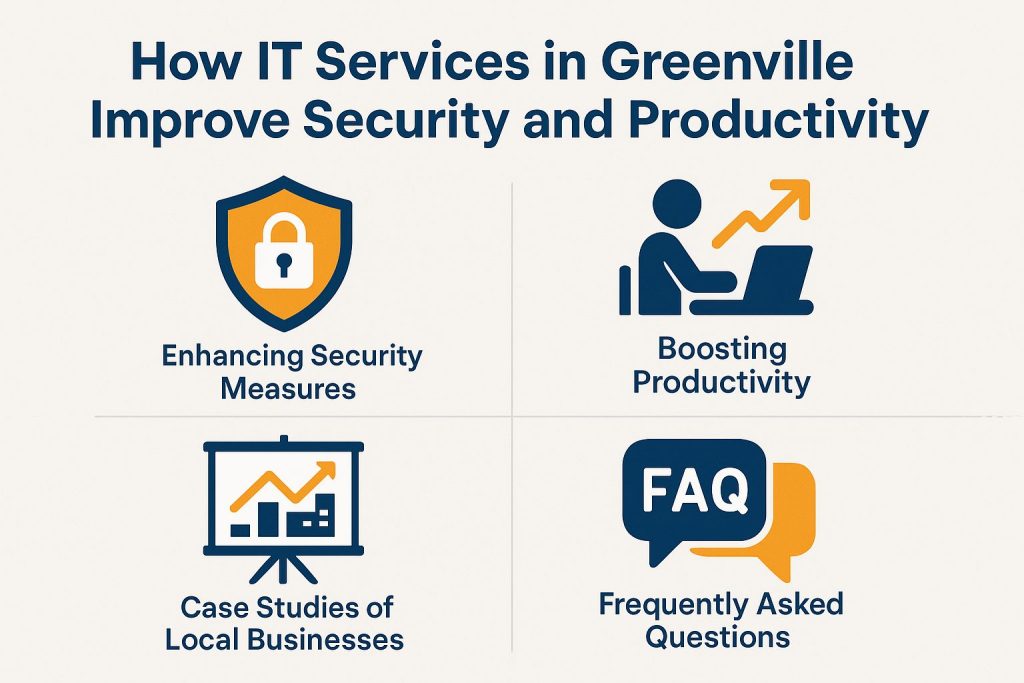
Case Studies: Productivity Gains
A manufacturing firm facing frequent server crashes and network connectivity issues partnered with a managed service provider, implementing 24/7 monitoring and proactive support. They achieved a 37% productivity boost, a 28% uptime gain, and saved $450k in lost revenue over one year. The implementation took just 90 days, starting with network monitoring tools and data backup solutions.
In the accounting sector, a firm used help desk integration from managed IT services to boost billable hours by 42%. Previously, staff lost time to software updates and phishing threats. The MSP deployed Microsoft Office 365 alongside cybersecurity measures in 60 days, with accountants now handling more cases efficiently.
A remote agency experienced 35% faster project delivery through unified communications. Scattered teams adopted tools like Slack and Zoom, integrated with cloud services for scalability. The result was higher employee productivity and cost effectiveness across distributed operations. Managed it services near greenville providers deliver these same measurable outcomes for Greenville businesses across every sector.
Measuring ROI on Managed IT
Managed IT delivers 347% ROI within 12 months through $1.2M savings vs $350k investment per Forrester study. ROI breaks down as: downtime savings at $560k, staff efficiency gains at $380k, and security avoidance contributing $240k by preventing costly cybersecurity threats.
Key metrics provide clear evidence of impact: MTTR drops from 4 hours to 45 minutes, ticket volume falls by 62%, and employee NPS rises 34 points from improved workplace happiness.
6-Month Implementation Roadmap:
- Month 1 — Assessment and Planning: Evaluate current IT infrastructure, identify pain points, and set baseline KPIs such as MTTR and ticket volume.
- Month 2 — Onboarding and Setup: Deploy 24/7 monitoring, help desk, and data security measures. Track initial downtime reduction.
- Month 3 — Core Integration: Implement cloud services, unified communications, and cybersecurity protocols. Measure staff efficiency gains.
- Month 4 — Optimization Phase: Fine-tune system performance with proactive support for Microsoft Office 365 and HR software.
- Month 5 — Testing and Scaling: Conduct simulated ransomware incident drills and ensure regulatory compliance.
- Month 6 — Review and ROI Calculation: Analyze full metrics including $1.2M savings and adjust for ongoing performance and growth.
Business it support greenville teams follow this structured approach to deliver sustained value. Regular KPI tracking during implementation confirms the path to 347% ROI, tying directly to how managed IT services improve system performance and employee output over time.
Frequently Asked Questions
What is the impact of managed IT on employee productivity?
Managed IT services positively transform employee productivity by providing reliable, proactive IT support that minimizes downtime and streamlines workflows. With expert monitoring and maintenance, employees spend less time troubleshooting tech issues and more time on core tasks, leading to measurable gains in efficiency and output.
How does managed IT improve productivity through reduced downtime?
Managed it services in greenville sc providers use 24/7 monitoring and rapid response protocols to prevent disruptions, ensuring employees remain focused and productive without interruptions from hardware failures or software glitches, cutting unplanned downtime by up to 88%.
In what ways does managed IT impact productivity in remote work scenarios?
The impact of managed IT on employee productivity is especially evident in remote and hybrid setups, where secure VPNs, cloud access, and device management keep distributed teams connected and efficient, eliminating connectivity hurdles and allowing seamless collaboration.
Can the impact of managed IT on employee productivity be quantified?
Yes, through metrics like uptime percentages (often 99.9%+), mean time to resolution under 1 hour, and productivity benchmarks showing 20-30% time savings per employee due to automated updates and optimized systems.
What role does cybersecurity play in the impact of managed IT on employee productivity?
Cybersecurity is central to productivity gains, as managed services deploy advanced threat detection, firewalls, and employee training to prevent breaches. This fosters a secure environment where workers avoid downtime from attacks and confidently handle sensitive data, supporting why managed IT reduces long-term stress for business owners.
How does cost-efficiency contribute to the impact of managed IT on employee productivity?
Predictable subscription models replace expensive in-house IT hires, freeing up budgets for tools that boost output. Scalable services align IT support with business growth, ensuring sustained productivity gains without the overhead of expanding internal teams.